Self-Cleaning Ovens: Do They Actually Work (or Are They Overrated)?
Self-cleaning ovens sound like the perfect solution — press a button and the oven cleans itself. But in reality, it’s not quite that simple.
This guide explains how self-cleaning ovens actually work, the different types available and what they do, what they clean well, what they don’t, and whether they’re worth relying on.
What Is a Self-Cleaning Oven?
A self-cleaning oven uses built-in technology to reduce grease and food residue without manual scrubbing. There are three main types — pyrolytic, catalytic and steam cleaning — and each works very differently, delivering very different results.
1. Pyrolytic Ovens — The “Real” Self-Cleaning Option
Pyrolytic ovens heat to between 400–500°C, burning grease and food residue into ash. Once the cycle is complete and the oven has cooled, you simply wipe out the ash residue.
What pyrolytic cleaning does well:
- Breaks down heavy grease and baked-on residue effectively
- Reduces the need for chemical cleaners
- Handles the kind of build-up that would require serious effort to remove manually
The limitations:
- Shelves and racks are usually removed before the cycle and cleaned separately
- Door glass is only partially cleaned — the outer pane and frame still need attention
- Seals and trims are not cleaned by the pyrolytic process
- High energy consumption compared to a standard oven cycle
- Produces a strong smell during the burn-off cycle
- Locks the oven door for safety throughout — typically 2–3 hours
The honest verdict: Pyrolytic is the only system that genuinely deep cleans the oven interior — but it’s not a complete solution and still requires manual finishing on certain areas.
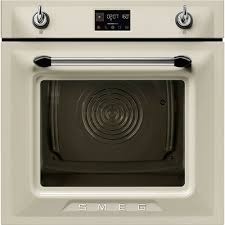
Shop Smeg Pyrolytic Ovens on Amazon →
2. Catalytic Ovens — The Misunderstood One
Catalytic ovens have special absorbent liners on the side and back walls that absorb and break down grease splatter during normal cooking. The idea is that grease is dealt with continuously rather than in a dedicated cleaning cycle.
What catalytic cleaning does well:
- Reduces grease build-up on the side and back panels over time
- Works passively in the background during cooking
The limitations:
- Only covers the side and back panels — not the oven base, door, shelves or fan area
- The catalytic liners wear out over time and eventually need replacing
- Doesn’t remove heavy or baked-on deposits — it slows accumulation rather than cleaning
The honest verdict: Catalytic liners help manage grease build-up on the surfaces they cover, but they don’t clean the whole oven and are often misunderstood as being more comprehensive than they are.
3. Steam Cleaning Ovens — The Lightest Option
Steam cleaning works by adding water to the oven base, heating it to create steam, and using the moisture to soften grime so it can be wiped away more easily.
What steam cleaning does well:
- Loosens light surface grease effectively
- Quick and low energy compared to pyrolytic cycles
- Easy to run as a regular maintenance step
The limitations:
- Doesn’t remove burnt-on carbon or heavy grease deposits
- Still requires significant manual wiping after the cycle
- More of a pre-cleaning aid than a standalone cleaning system
The honest verdict: Steam cleaning is useful for maintaining a relatively clean oven but shouldn’t be confused with a deep cleaning system.
The Biggest Misconception About Self-Cleaning Ovens
Here’s the key point most people don’t realise: no self-cleaning oven cleans everything.
Even the most powerful pyrolytic systems don’t fully clean the door glass, shelves and racks, door seals, or fan areas. Every self-cleaning oven still requires some manual finishing — the difference is in how much.
This is where a lot of disappointment comes from. People expect to press a button and open a spotless oven. What they get is a significantly cleaner oven that still needs attention in certain areas.
Real-World Performance
| Type | Cleaning Power | Effort Required | Coverage |
|---|---|---|---|
| Pyrolytic | High | Low–Medium | Partial |
| Catalytic | Medium (over time) | Low | Limited |
| Steam | Low | Medium | Limited |
Are Self-Cleaning Ovens Worth It?
Yes — but only if you understand their limits.
They’re genuinely useful for reducing build-up, cutting down cleaning frequency, and making maintenance easier. They’re not a complete replacement for cleaning, and they’re definitely not a set-and-forget solution.
If you’re considering a pyrolytic oven specifically for the self-cleaning feature, it’s worth having — but go in with realistic expectations about what it will and won’t handle.
The Practical Approach
The most effective way to manage a self-cleaning oven is to combine the built-in cleaning function with a few simple habits:
- Use the pyrolytic or steam cycle regularly rather than waiting until the oven is heavily soiled
- Use an oven liner on the base to catch spills before they burn on
- Do occasional manual cleaning on the areas the system doesn’t cover — door glass, seals and shelves
That combination works far better than relying on any single system alone.
The Professional Perspective
From a professional cleaning standpoint, self-cleaning ovens reduce the workload — but they don’t eliminate it. Even high-end pyrolytic ovens still accumulate carbon in certain areas, require occasional detailed cleaning, and need attention to parts the automated system doesn’t reach.
One important note: never use chemical oven cleaners on a pyrolytic oven. The caustic chemicals in products like Oven Pride or Mr Muscle will damage the pyrolytic coating permanently. If a pyrolytic oven needs manual cleaning, use a non-caustic bio cleaner only.
Final Verdict
Self-cleaning ovens are useful but frequently misunderstood.
Pyrolytic is powerful but incomplete. Catalytic is helpful but limited in coverage. Steam is convenient but light-duty. All three are best seen as maintenance tools that reduce cleaning effort — not systems that replace cleaning altogether.
Quick Summary
| Feature | Self-Cleaning Ovens |
|---|---|
| Fully automatic cleaning | No |
| Reduces cleaning effort | Yes |
| Handles heavy grime | Partially (pyrolytic only) |
| Replaces manual cleaning entirely | No |
| Safe to use chemical cleaners on | No — non-caustic only |