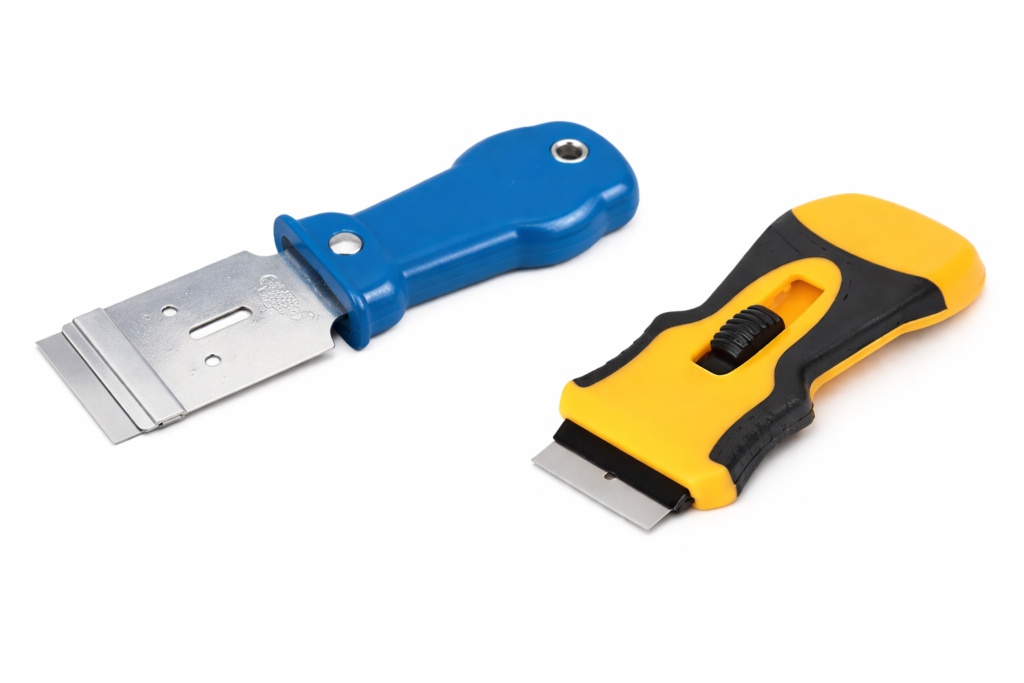
I’ve cleaned hundreds of ovens over the years, and one of the questions I get asked most often is what tools I actually use. People expect some big secret. The scraper is always the one that surprises them — because it looks like nothing.
But get this wrong and you’ll make your life way harder than it needs to be. So let me tell you exactly what I use, what I avoid, and why.
The Retractable Scraper: Leave It on the Shelf
You’ll see these everywhere — supermarkets, pound shops, hardware stores. A plastic body, a sliding mechanism, and a razor blade that clicks out when you push a button. They’re not labelled as professional scrapers, and there’s a reason for that.
The mechanism is the problem. Use one regularly with any real pressure and it starts to go. The blade won’t stay extended. You’re clicking it back out every few strokes, you lose your rhythm, your pressure becomes uneven — and uneven pressure on an oven door is how you end up with scratches. I’ve seen it happen. It’s not a pleasant conversation with a customer.
Even if you only clean your own oven a few times a year, these things have a habit of failing at exactly the wrong moment. Save yourself the frustration.
The Professional Scraper: What I Actually Use
A proper professional scraper is almost insultingly simple. Solid moulded handle — chunky, ergonomic, fits properly in your hand. The blade slides into a fixed slot in the holder. That’s the entire design. No spring, no ratchet, no mechanism of any kind.
The blade stays out because the holder holds it. You push as hard as you need to. It doesn’t move. The only way you’ll break it is if you’re really forcing it at a bad angle — and if you’re doing that, you’re doing it wrong anyway (more on that in a moment).
When a blade gets too dirty or starts to dull, you swap it out. Fresh blade, same handle, carry on. Simple, reliable, and the same tool that professional oven cleaners, window cleaners and kitchen fitters have been using for years. There’s a reason we all use the same thing.
This is the one I’d recommend — grab it on Amazon here.
The Rule That Matters More Than Anything Else
Whichever scraper you use, this is non-negotiable: keep the blade flat.
Flat. Against the surface. Almost parallel to it. Not tilted, not angled up, not twisted. Flat.
The moment you tip the blade onto its edge — even slightly — you’re dragging a razor across your oven glass or ceramic surface. That’s a scratch, and it’s permanent. I’ve walked into jobs where someone has had a go themselves and done exactly this. There’s nothing you can do about it after the fact.
The technique is slow and deliberate. Short strokes. Consistent pressure. Wipe the blade clean regularly so you’re not dragging debris back across the surface. Let the blade do the cutting — you’re just guiding it. If something isn’t shifting, more soak time is the answer, not more force.
A Word on Safety
These are razor blades. Treat them like it.
- Always cover or retract the blade when you’re not actively using it
- Don’t leave it sitting blade-up on a surface — ever
- Gloves are a good idea, especially when your hands are wet and greasy
- Wrap old blades in tape before binning them — don’t just drop a bare blade in the bin
- Keep them well out of reach of children
The Bottom Line
A professional scraper costs next to nothing and will last you years. The retractable ones can cost about the same and will let you down. It’s not a difficult decision.
Get the right tool, keep it flat, take your time — and your oven glass will come up clean without a mark on it.